Ingest everything
Email, file systems, EDI, and manual uploads feed one Accounts Payable intake layer.

Platform capabilities
insors combines intelligent document orchestration, region-aware extraction, advanced matching logic, pricing automation, and tax validation into a governed Accounts Payable workflow.
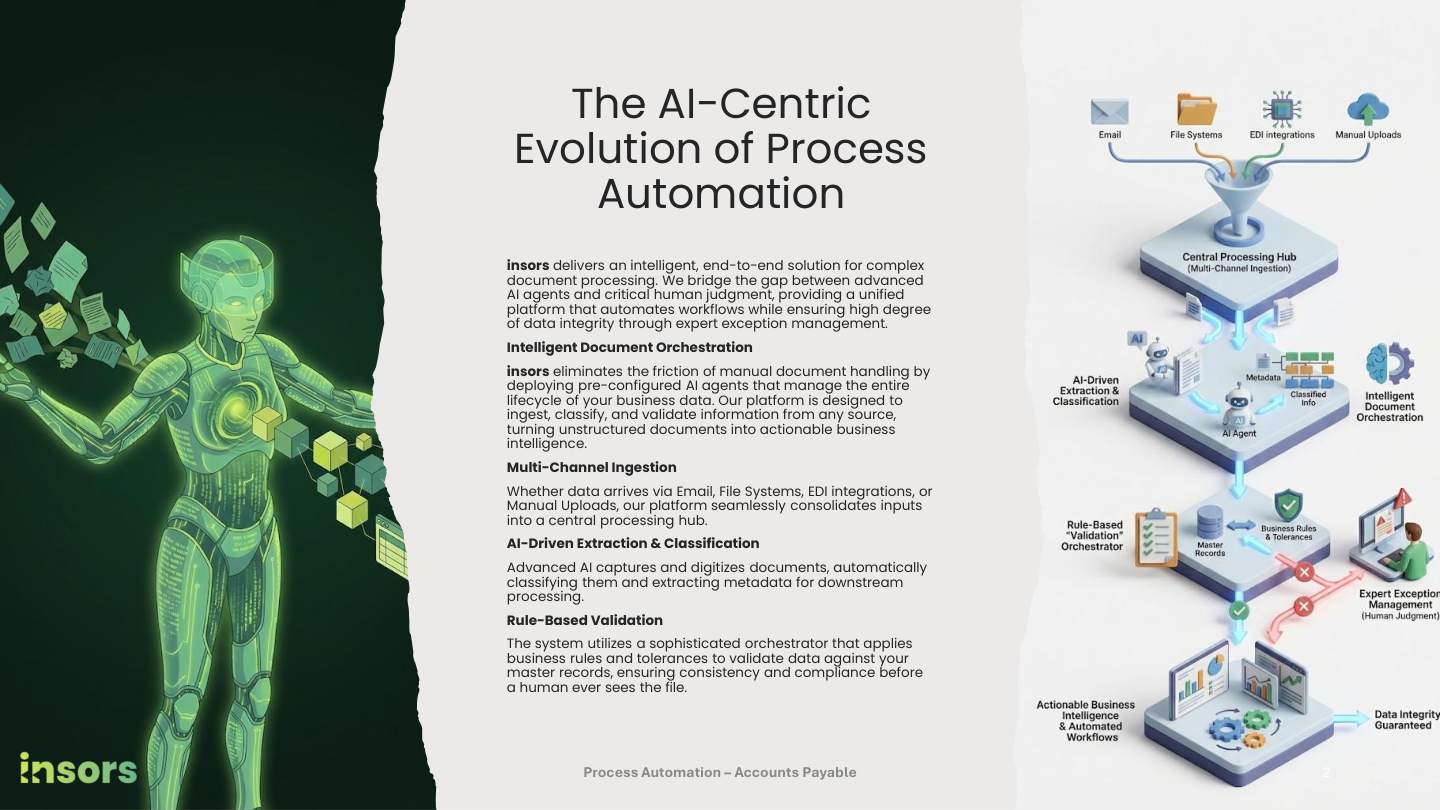
Workflow orchestration
Email, file systems, EDI, and manual uploads feed one Accounts Payable intake layer.
AI agents capture invoice content, classify documents, and prepare metadata for the next step.
Master data, tolerances, business rules, and compliance checks run before human intervention.
Reviewers see only the cases that need judgment, with context already assembled.
Document understanding
The model is built to recognize local identifiers, tax regimes, payment practices, and contractual language while continuing to learn from new supplier formats.
PAN, GSTIN, VAT, and related registration credentials are treated as first-class data points.
GST, VAT, excise, withholding, and multi-rate structures are handled directly in the extraction flow.
Payment infrastructure, legal clauses, and localized terms and conditions can be interpreted and enforced.
Continuous refinement improves performance as templates, layouts, and vendor behavior evolve.
Advanced Accounts Payable controls
Supports UoM normalization, price and quantity checks, discount and tax validation, SKU similarity, and scan-tolerant matching.
Best-fit PO prediction handles missing or unreadable PO numbers, partial fulfilments, and multi-PO invoices.
Fuzzy checks across vendor, invoice number, amount, date, line structure, and OCR similarity catch exact and near duplicates.
Historical postings, vendor patterns, and indirect spend behavior inform GL suggestions and anomaly detection.
Contracts, rate cards, emails, chats, and pricing schedules feed a machine-readable pricing master with analytics and governance steps.
Live GST rule alignment, HSN/SAC mapping, reverse-charge validation, and auditable exception flags reduce compliance risk.
Control without rigidity
Business rules can be tuned at invoice or item level, aligned to vendor SLAs, contract thresholds, and risk tolerance so the platform can push routine work straight through and isolate only material exceptions.
Continue to impact and case study